Students ask this more often than any other question, usually in a slightly guilty tone: am I allowed to do this?
Yes. Checking your own draft before you hand it in is ordinary academic practice, and plenty of universities provide it themselves.
Why institutions offer it
Many universities run a "draft" or "self-check" submission point precisely so students can see a similarity report before the graded one. The reasoning is straightforward: most similarity problems are mistakes, not dishonesty — a quotation that lost its quotation marks in editing, a citation dropped while reorganising, a paraphrase that stayed too close to the original. Finding those before submission is better for everyone.
If your department has a draft submission point, use it. It is free and it is theirs.
Plenty of students have no such thing — no draft folder, or one that only opens in the last week of term, or a supervisor who cannot run it for them. That gap is why services like this exist.
What you are allowed to do
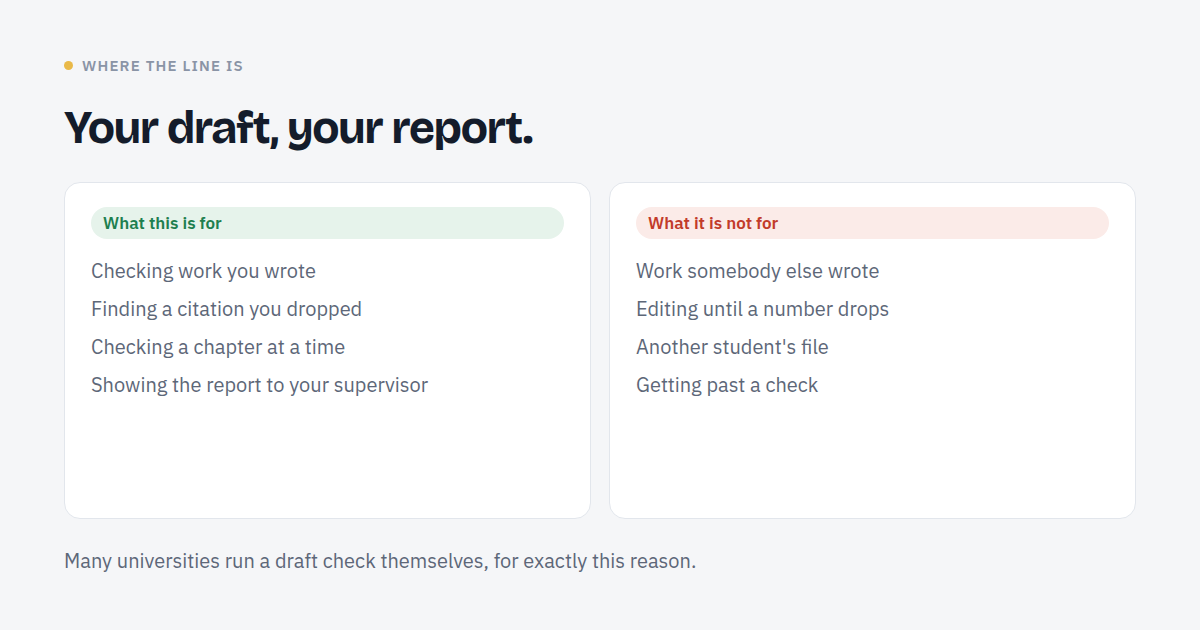
Check work you wrote. Read the report, find matches you did not intend, fix them, submit better work. That is the whole purpose.
Check a draft more than once. Nothing here is stored, so a second check does not match the first. That matters: if your university keeps submitted papers, a draft you submitted there can match your own final version and produce an alarming percentage from nothing.
Check a chapter at a time. Especially for a thesis, where by the time the whole thing is assembled it is too late to restructure.
Show the report to your supervisor. It is your report about your work.
Where the line is
This is worth stating plainly, because a service like this could be used for something else.
Work you did not write is still work you did not write. A report on a purchased essay, a friend's paper or an AI-generated draft tells you how likely you are to be caught. It does not make the work yours, and running it through a check does not change what happens when someone reads it properly.
A score is not a target. Editing until a number goes down, rather than until the writing is right, is optimising for the wrong thing — and it usually produces worse writing that still has the original problem underneath.
Nobody's file but your own. Uploading another student's work — to see how they did, to check on them, for any reason — is not yours to do.
We do not publish guides to getting past a check, and support will not help with it. Everything here is built for the student who wrote the thing and wants to know what their department is about to see.
Keeping it yours
Two practical points, both about not leaving traces:
Check that nothing is being stored. Ask any service whether your file is added to a repository. If it is, your own submission may later match your own draft, and you will spend an afternoon explaining yourself. Every check here runs in no-repository mode: nothing of yours is added to any database, and the file and both reports are deleted 24 hours after the results are ready.
Take your name out first. There is no reason for a file you are checking to carry your name, your student ID or your university. Here is the rest of what to remove.
If your department asks
Say what you did: you checked a draft of your own work before submitting it, the way a draft submission point would, and here are the drafts that show how the writing developed.
Keeping your drafts and notes is the single most useful habit in all of this. A version history answers the question that no percentage — similarity or AI — can answer on its own: did you write it?