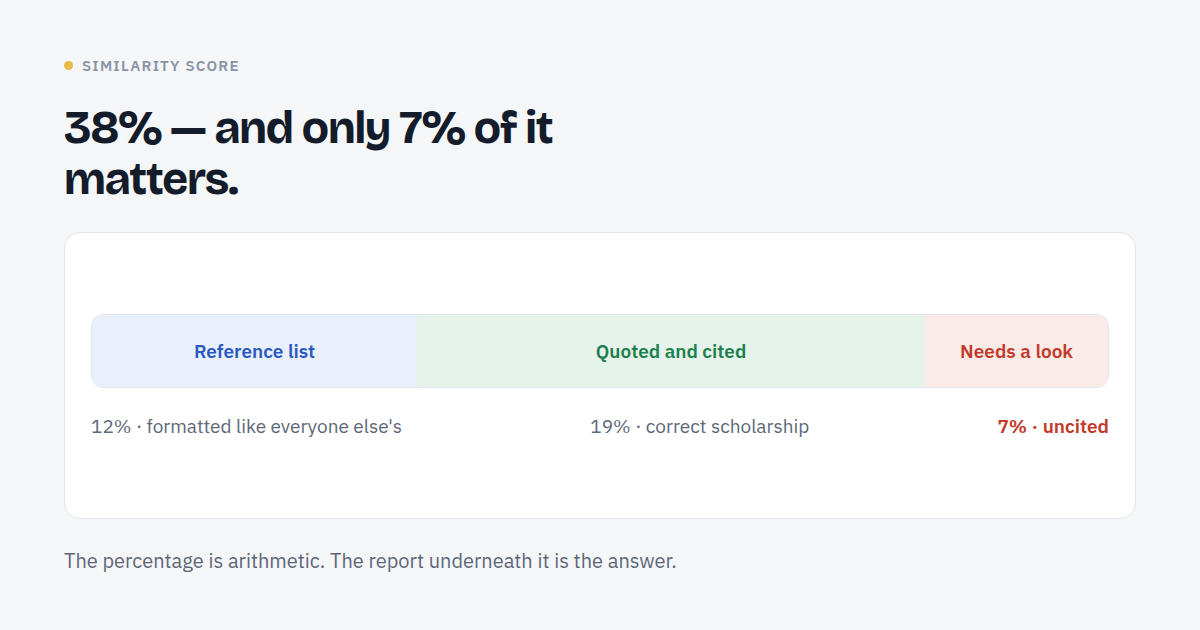
A similarity report comes back at 38% and the first thought is always the same: am I in trouble?
Probably not. But the number by itself cannot answer that question, and treating it as a grade is the most common mistake students make with these reports.
What is being counted
The check compares your text against a very large collection of documents — published papers, books, web pages, and student work that institutions have submitted over the years — and reports how much of your text matches something in it.
A match is a match. The system does not know, and does not ask:
- whether the matching passage is inside quotation marks
- whether you cited it properly on the same line
- whether it is your own reference list
- whether it is a phrase every paper in your field uses
All of that counts. Which is why the percentage on its own tells you very little.
Why a careful paper can score high
Your reference list. Thirty references, formatted exactly as everyone else formats them, each one matching the same reference in a hundred other papers. That alone can be several percent of a short essay, and much more of a long one with a heavy bibliography.
Quotations. You quoted a source, you put it in quotation marks, you cited it. Correct scholarship — and a match.
Standard phrases. The aim of this study is to… as shown in Table 3… statistically significant at the 0.05 level. Nobody invented those. Everybody uses them.
Your own earlier work. If your university stores submitted papers, a draft you handed in last term can match the final version you hand in this term. This is a real and frustrating cause of high scores. (It is also why every check here runs in no-repository mode: your file is never added to any database, so checking a draft with us cannot come back to haunt the final version.)
A common topic. Write about photosynthesis or the causes of the French Revolution and you are writing about something thousands of people have written about, in the words the field uses.
So what is a good number?
There is no such number, and anyone who gives you one is guessing.
A 40% report that is entirely quoted, cited material and a reference list may be perfectly sound. A 6% report can be a serious problem if those six percent are an uncited paragraph lifted from someone else's paper.
What matters is where the matches are, and your department — not us, and not the percentage — decides what is acceptable. Some set a threshold as a rough filter; most look at the report.
How to read the report properly
Open the PDF and work through it rather than stopping at the front page.
- Look at the biggest single match first. One long unbroken block of matched text matters far more than fifty scattered three-word phrases. The report lists matches by size for exactly this reason.
- Check what each match is. Your own reference list? A quotation you marked? Then it is doing no harm.
- Find anything unquoted and uncited. This is the only part that should worry you. A paragraph that matches a source, with no quotation marks and no citation, is the thing to fix — and you have time to fix it, because you are reading this before your department does.
- Ignore the percentage while you do all this. Come back to it at the end, when you know what it is made of.
The practical version
Before you submit, check the work, then spend ten minutes inside the report rather than ten seconds on the front page. What you are looking for is not a number to be under — it is any passage that is someone else's words pretending to be yours.
Everything else is just the arithmetic of writing in a field where other people have written before you.