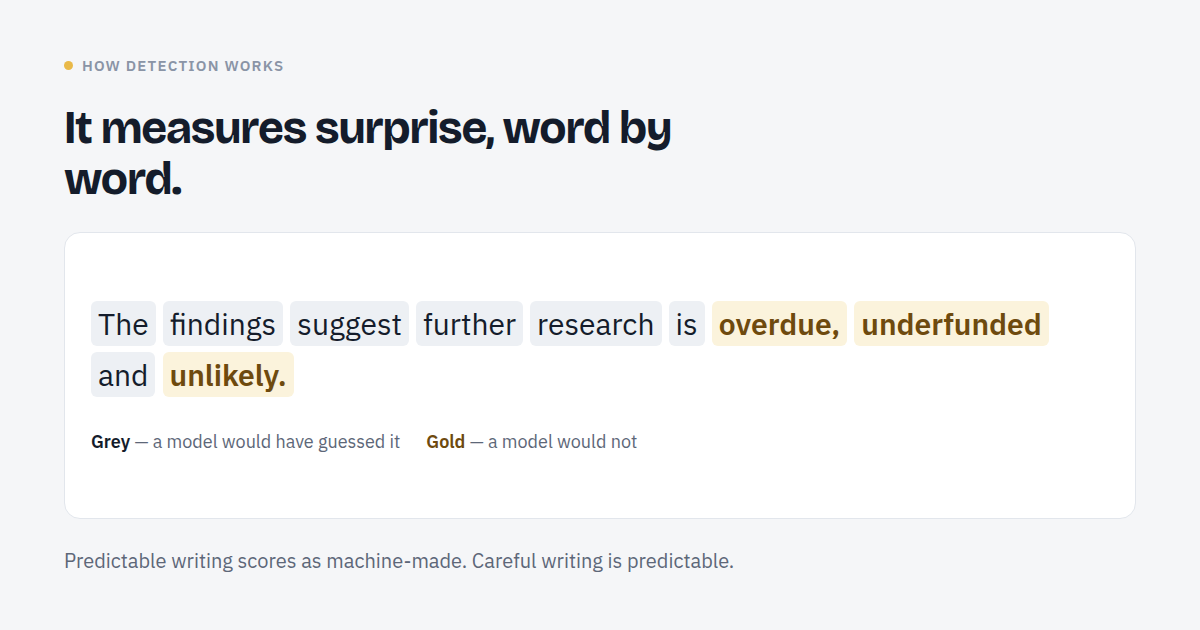
People talk about AI detectors as though they can recognise machine writing the way a bank recognises a forged note. They cannot. Nothing in the text carries a mark saying where it came from, and no detector is looking for one.
What a detector does is simpler, and worth understanding — because once you know what is being measured, both the false alarms and the limits of the whole idea stop being mysterious.
It measures predictability
Take a sentence and remove the last word: The findings suggest that further research is …
You can probably guess "needed". So can a language model, with very high confidence. Now try: The findings suggest that further research is overdue, underfunded and, in this department, unlikely.
That ending is a surprise. A model would not have picked those words.
A detector runs your whole text through a language model and asks, word by word, how surprised would a model be here? Text where nothing is surprising scores as machine-like. Text full of small surprises scores as human.
There is a second measurement alongside it: how much the surprise varies. People write unevenly — a long involved sentence, then four words. Models write at a steady level. A text with a flat, even rhythm looks machine-made; one that lurches about looks human.
That is essentially the whole technique. Predictability, and variation in predictability.
Why honest writing gets caught
Read those two measurements again and you can see the problem immediately: they describe plain, even, careful prose. Which is exactly what students are taught to write.
- A clear, well-edited essay is more predictable than a messy one.
- Academic conventions exist precisely so that everyone phrases the same things the same way.
- A writer working in a second language sticks to patterns they are sure of, and avoids the idiom and irregularity that mark a text as human.
- Running the text through a grammar tool smooths out the remaining bumps.
So a student who writes carefully, edits properly and follows the conventions of their field is producing exactly the signal a detector reads as artificial. That is not a bug in one product; it follows from what is being measured.
The reverse is also true. A person who writes with obvious personality, mixed sentence lengths and the occasional odd word choice will score low — whether or not they wrote it themselves.
What that means for the number on your report
A high AI score means: this text is unusually predictable. That is all it means. It is a statement about the writing, not about the writer, and it is never evidence on its own that anyone did anything.
Some universities have grasped this and stopped using AI scores in misconduct cases. Others have not, which is why it is worth seeing your own number before your department does — not to change it, but to know what is about to land on someone's desk and to have your drafts ready if a conversation follows.
About the tools that promise to hide it
There is a whole industry selling "humanisers": paste in AI text, get back text that scores lower. They are worth being clear about.
What they do. They swap words for synonyms, reorder clauses and insert irregularity — manufacturing the surprise a detector looks for. They do not make the writing better, and usually make it worse: wrong register, odd word choices, sentences that no longer say quite what they said.
Why it is a bad bet. The output often reads strangely to a human marker, who is not measuring perplexity but noticing that a paragraph does not sound like the rest of your work. Detectors also change; text tuned against last year's is not tuned against next year's. And if the original text was not yours, the tool has not solved that problem — it has only changed the wrapper on it.
Where we stand. We do not publish guides to getting past a check, and we will not help with it in support. This service exists so that you can see what your department will see. If the honest answer to "did you write this?" is no, no score and no tool fixes that, and it is not what we are for.
If the answer is yes and the number still looks wrong, that is a real problem worth solving — and we wrote a whole page about it: why an AI score reads high on work you wrote yourself.
The short version
A detector measures predictability and calls unpredictability human. That catches some machine writing, misses some more, and flags careful people writing carefully. Read the number as one weak signal among several, keep your drafts, and write things only you could have written — which is the only approach that survives whatever the detectors do next.