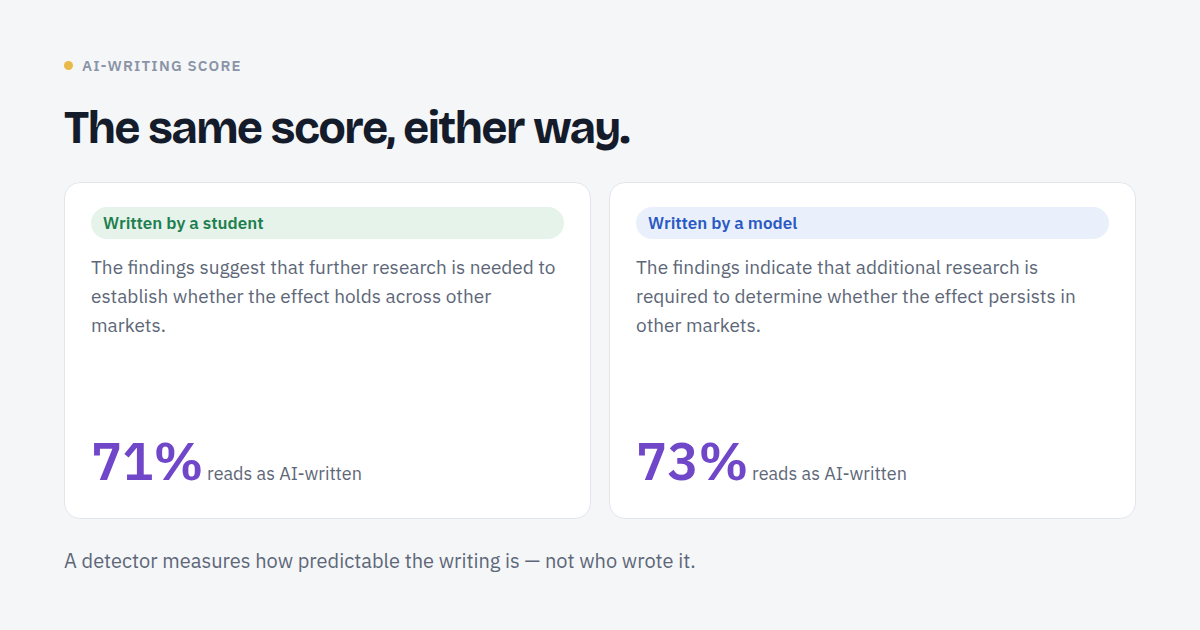
You wrote every word. You sat with it for a week. The report comes back and says the writing reads as AI-generated, and your stomach drops.
This happens often enough that it is worth explaining properly, because the number is easy to misread — by students, and sometimes by the people marking the work.
An AI score is a guess about style
A similarity score is a measurement. It compares your text against documents that exist and reports what matched: this sentence, that source, this much of it. You can open the report and see every match.
An AI-writing score is not that. Nothing is being compared against anything. A model looks at your sentences and estimates how closely they resemble the way a language model writes — how predictable each word is given the words before it, how even the rhythm is, how little the sentence length varies.
That is a guess about style. It is not evidence about authorship. Those are different claims, and only the first one is being made.
What pushes the number up on honest work
Four things reliably raise an AI score on writing a person did themselves.
Plain, careful prose. The clearer you write, the more predictable you are. An essay with short declarative sentences and no flourishes looks, to a detector, exactly like a model trying to be helpful. Students who write well and simply are penalised more than students who ramble.
Heavy editing. Grammar tools, a spell checker, a rewrite of every awkward sentence — each pass smooths the writing towards the average. The oddities that mark a text as human are exactly what editing removes.
Standard academic phrasing. This paper examines… The findings suggest… Further research is needed… Every discipline has a set of phrases everyone uses, because they are the accepted way to say those things. They are also the phrases a model reaches for first.
Writing in a second language. If you compose carefully, keep to sentence patterns you are confident in, and avoid idiom, your writing becomes more regular — and regular reads as machine-made. This is the one that bothers us most, because it means a student writing in English as a second language can be flagged for being careful.
What the number is worth
Treat it the way you would treat a smoke alarm in a kitchen: worth a look, not proof of a fire.
A high score is a reason to re-read your own work and ask whether it sounds like you. It is not, on its own, evidence of anything — and no serious institution should treat it as such. Several universities have said as much publicly, and some have stopped using AI scores in misconduct cases altogether for exactly this reason.
We pass on what the check reports. We do not judge the work, and the report does not accuse anyone of anything.
What actually helps
Not tricks. Tools that promise to "humanise" text work by shuffling words and inserting noise — they damage your writing, they are detectable in their own way, and using one on work you wrote yourself means degrading good writing to satisfy a number. If you did not write it, that is a different problem and no tool fixes it.
What does help is writing that could only have come from you:
- Say where things came from. In the 2019 survey by Rahman, of the 120 shoppers who… — specific, attributable, and unlike anything a model invents.
- Use your own examples. Something you observed, something from your fieldwork, something from your own city. A model cannot produce your data.
- Let the sentences vary. A long one, then a short one. That variation is one of the strongest signals of a human hand.
- Argue with something. Disagreement, hedging, an admission that a result was disappointing — models write confident, agreeable prose by default.
- Keep your drafts. Version history, notes, an outline. If anyone ever questions the work, the drafts settle it in a way no score can.
Before you hand it in
Check it, read the number, and read the report underneath the number. If the AI score is high and you wrote the thing, you have not done anything wrong — but it is useful to know before your department sees it, rather than after.
That is the whole reason this site exists: the same reports your institution gets, in your hands first, while there is still time to look at them.